
Car Seat History is fascinating and oftentimes hilarious!
At phil&teds®, we’re parents too, so we understand the everyday challenges that come with raising small humans. One of the biggest (and most important) decisions parents face is choosing the right car seat for their child.
What many people don’t realise is just how far car seats have come — and how hilariously awkward their beginnings really were. This is a short, eye-opening look at the evolution of child car seats, from well-meaning contraptions to the highly engineered safety systems we rely on today.
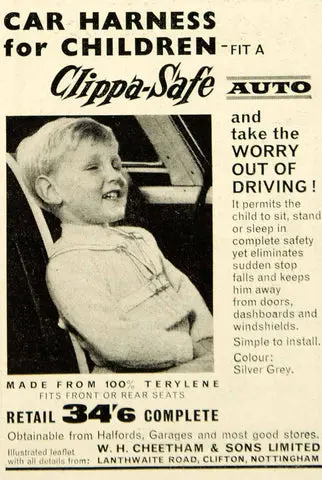
A Time Before Rules (and Common Sense)
Car seat manufacturing and safety testing didn’t become regulated until 1971. Everything sold today is the result of decades of improved testing, research, and regulatory advancement.
Fast forward to now, and modern car seats are tested to some of the most rigorous safety standards in the world. At phil&teds®, our car seats meet multiple recognised international regulations, including ECE R44/04, the newer and more advanced ECE R129 (i-Size), AS/NZ 1754, and FMVSS 213. Each standard reflects evolving knowledge around crash dynamics, child anatomy, and real-world use (and yes — we’ll unpack what they all mean in another post).
R129, in particular, represents a major step forward. It introduces enhanced side-impact testing, improved head and neck protection, and height-based sizing — all designed to better protect children as they grow.
But before safety became the focus, child car seats served a very different purpose and spoiler alert: it wasn’t protection.
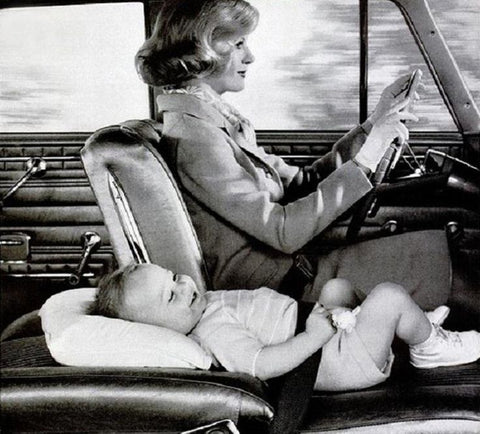
When Car Seats Were Just… Restraints
In the early days, car seats weren’t designed to keep children safe in a crash. They were designed to keep kids contained.
The logic went something like this:
“What’s more distracting than a toddler roaming freely around a moving vehicle?”
That was the problem being solved. Safety wasn’t even part of the conversation. For context, seat belts didn’t become mandatory in all vehicles until the 1960s.
Pre-1930s to the 1940s: So, They Could See
Large-scale child car seat manufacturing began in the early 1930s. These early designs weren’t about protection — they simply elevated children so they could see out the window.
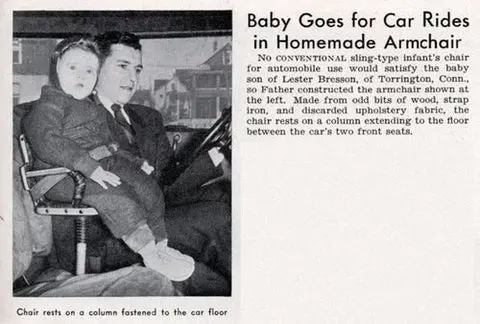
In 1933, the Bunny Bear Company produced the first widely distributed child car seat. By today’s definition, it resembled a booster seat and draped over the back of a bench-style car seat.
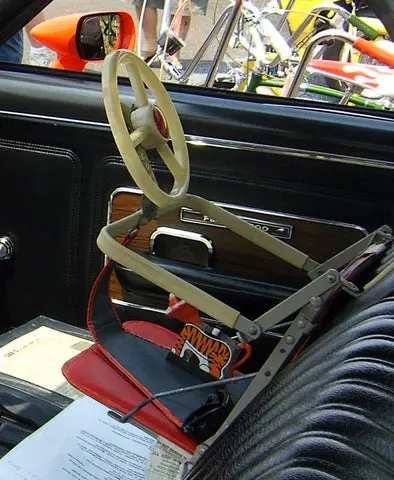
It solved two problems:
- It restrained the child
- It raised them up to see
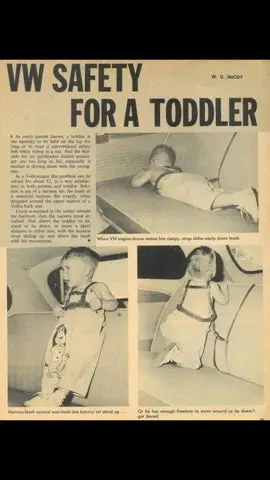
Other similar devices followed, including child harnesses sold by manufacturers like Volkswagen all well-intentioned, but wildly inadequate by today’s standards.
The 1950s: Seat Belts Change Everything
Before 1960, doctors made up a large portion of early seat belt users largely because they were treating crash victims daily. These belts were often homemade or fitted by mechanics.
In 1955, Volvo changed the course of vehicle safety by offering seat belts as standard. This innovation paved the way for safer child restraints.
The 1960s: Safety Finally Enters the Chat
The early 1960s marked a turning point. Two inventors Jean Ames (UK) and Leonard Rivkin (USA) independently designed car seats that used the vehicle’s seat belt.
- Ames created a rear-facing seat, not unlike modern designs
- Rivkin developed a forward-facing seat with a metal frame
These ideas seeded what would become the cornerstone of car seat design: safety.
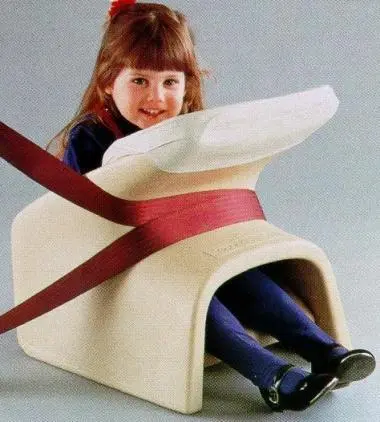
One early mass-produced example was Ford’s 1968 Tot-Guard, a plastic seat with a padded shield designed to cushion a child on impact an important step, even if it looks terrifying by today’s standards.
1971: The Moment Everything Changed
It wasn’t until 1971 that child car seat safety regulations were introduced. From this point on, manufacturers were required to prioritise safety and the modern era of car seat design truly began.
The 2000s and Beyond: Safer Than Ever
Today, child car seat safety has never been stronger. Seats are subject to rigorous testing, quality assurance processes, and independent third-party evaluations from organisations such as CREP, ADAC, and Stiftung Warentest.
But even the safest seat in the world won’t protect a child if it’s installed incorrectly.
According to an NZ Police and Plunket survey, 85% of child car seats in New Zealand are incorrectly installed. When purchasing a car seat, use all available resources, consult your retailer, and if in doubt, visit a Certified Child Restraint Technician to have your seat checked.
Because safety doesn’t stop at design it continues with correct use.
We’d love to see how far we’ve come.
Feel free to comment with photos of your antique or vintage car seats the good, the bad, and the truly unbelievable.