
A brief history of the stroller: from babywearing to modern mobility
Parents throughout history have always faced the same fundamental challenge: how do you safely and comfortably transport a baby while still getting on with daily life?
At phil&teds®, we’re parents too, so we get it. The juggle, the logistics, the need for freedom alongside care. While the tools may have changed over time, the purpose hasn’t. That’s where the stroller story begins.
The baby carriage has been around for more than three centuries. Once reserved for aristocracy, the rich, and the powerful, prams, buggies and strollers are now an essential part of everyday life for parents everywhere. Let’s take a look at where they began, and how they evolved into the modern strollers we rely on today.
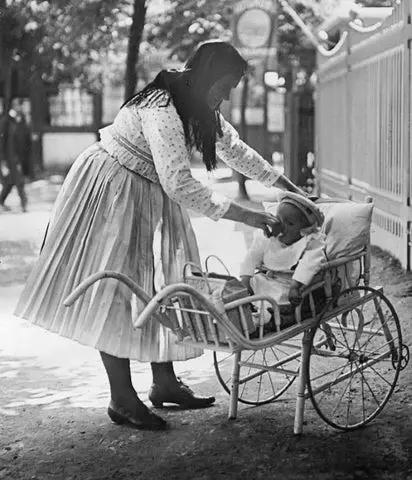
Before the stroller: babywearing through the ages
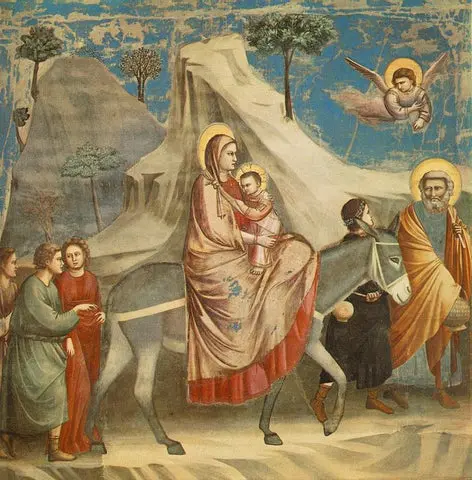
Before strollers existed, babies were carried in slings, baskets, and on backs or chests. Babywearing dates as far back as ancient Egypt, during the time of the pharaohs. One of the earliest recorded depictions appears in 1306, when artist Giotto painted Mary carrying baby Jesus in a sling.
Long before wheels entered the picture, parents were already innovating — adapting to life with a child in tow.
The 1700s: the stroller makes its debut
The first known stroller emerged in the early 1700s, designed by William Kent, a landscape architect. Created for the Duke of Devonshire, it was intended to amuse his children while they travelled outdoors.
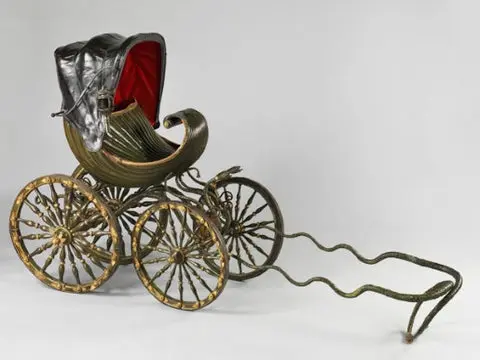
These early baby carriages were luxury items, and not exactly practical by today’s standards. They were designed to be pulled, often by ponies, dogs or even goats, rather than pushed by a parent.
The 1800s: pushing progress forward
It wasn’t until the following century that the stroller truly began to resemble something usable. Benjamin Potter Crandall introduced a design that could be pushed by hand, a radical shift at the time.
Although initially dismissed by the mainstream and still considered a luxury, the design evolved under his son, Jesse Armour Crandall, who added practical features like brakes, folding frames, parasols and accessories.
A pivotal moment came when Queen Victoria publicly purchased three strollers. Almost overnight, they became a must-have for mothers across the country.
The perambulator: a defining moment
As the 19th century progressed, strollers became more accessible across all economic classes. Urban parks expanded, pavements improved, and fresh air and sunlight were increasingly linked to good health, all of which encouraged families to head outdoors.
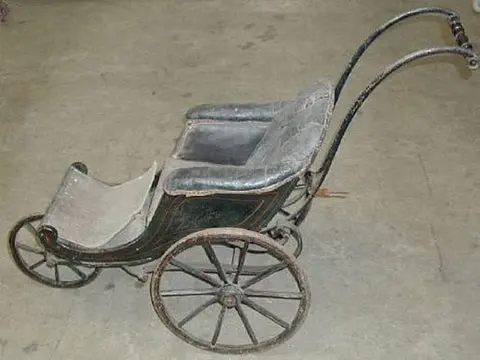
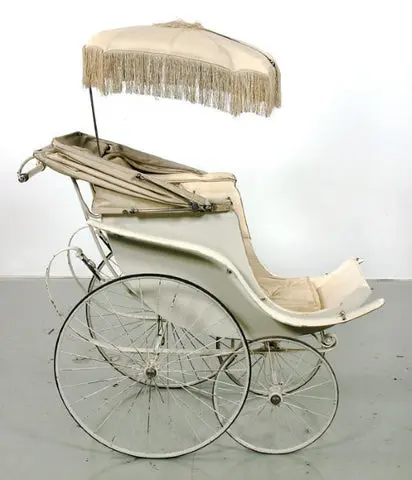
Enter the perambulator, designed by Charles Burton. With its three-wheel design and oversized spoked wheels, it looked more like a rolling sofa than a modern pram. Early feedback wasn’t kind; “unwieldy” and “hard to control” were common complaints.
Undeterred, Burton took his design to England. It initially struggled until the royal family adopted it. From there, it quickly gained popularity throughout the UK. This is why the word “pram” (short for perambulator) is still commonly used today.
Innovation and inclusion
Another major leap came from the United States, thanks to William H. Richardson, an African American inventor. He patented a design that allowed the seat to face both forwards and backwards, giving parents the choice to interact with their baby or let them explore the world.
Richardson also introduced independently rotating wheels, dramatically improving manoeuvrability, a feature we now take for granted.
Expansion, twins and the umbrella stroller
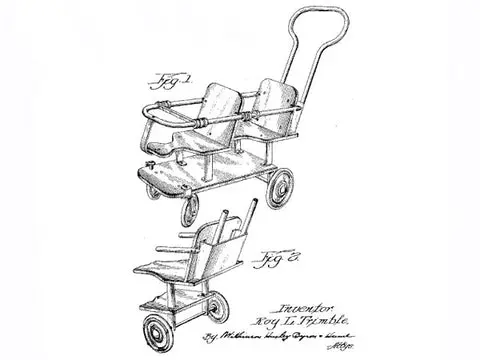
By the late 19th century, strollers evolved to accommodate multiple children, particularly twins. These early models resembled long, trolley-style designs and were popular until the outbreak of World War I.
One of the most influential innovations arrived in the 1960s with the invention of the umbrella stroller. Designed by an avionics engineer, its lightweight aluminium frame and compact fold laid the foundation for modern stroller design.
Today, strollers come in all shapes and sizes, from all-terrain adventurers to compact travel designs small enough for overhead luggage compartments.
Why it matters
Looking back at the history of the stroller reminds us that innovation has always been driven by care — by parents adapting to life with children and seeking better ways to move through the world together.
At phil&teds®, that same thinking guides everything we design today.
Curious how child travel safety has evolved alongside strollers?
👉 Check out our history of car seats here.
Have, an antique stroller tucked away at home? We’d love to see it, share your photos in the comments 💛